
The competitive divide in utility AI is increasingly determined by operational coordination speed.
Utilities generate vast amounts of AMI IoT operational data across AMI networks, IoT devices, GIS platforms, OMS environments, SCADA systems, DER operations, and field workflows. Yet many organizations still struggle to maintain a synchronized operational view of the grid when outages, load fluctuations, asset events, and customer demand changes occur simultaneously, limiting real-time grid visibility when it matters most.
As utilities expand AI adoption, the challenge is no longer collecting more data. The challenge is ensuring that operational data remains connected, synchronized, and actionable across systems. When AMI, IoT, GIS, OMS, and operational platforms function independently, utilities create fragmented data environments that slow decision-making, reduce AI reliability, and weaken enterprise-wide operational awareness.
Successful utility AI initiatives depend on a strong operational data foundation that unifies telemetry, operational state, asset context, and decision intelligence. Utilities that establish this foundation are better positioned to support event-driven operations, improve grid responsiveness, and support future AI initiatives across the enterprise utility systems.
This shift is moving the industry beyond isolated integrations and toward utility operational architectures designed for continuous synchronization, enterprise-wide visibility, and AI-ready utility operations.
Why Utility AI Depends on Operational Synchronization
Operational coordination speed is now one of the defining enterprise AI adoption challenges separating utilities that scale AI from those that don’t.
Most utility modernization programs still focus heavily on integration volumes.
More systems are connected. More telemetry collected. More operational feeds are centralized.
But operational synchronization remains weak underneath the architecture.
Utilities frequently connect systems technically while leaving operational states disconnected. AMI updates may arrive faster than OMS updates. GIS hierarchies may conflict with asset records. IoT telemetry may stream continuously while operational workflows still rely on delayed synchronization cycles. AI systems inherit instability.
Connected Systems Still Create Operational Inconsistency
Utilities often assume operational modernization succeeds automatically once systems begin exchanging data.
An AI model processing transformer health data becomes unreliable when:
- Outage systems update later than telemetry streams
- Asset hierarchies differ between GIS And EAM platforms
- Telemetry timestamps drift across environments
- Field updates remain disconnected from operational workflows
The systems communicate, but the operational context does not align.
Under live operational pressure, misalignment spreads quickly across outage coordination, forecasting accuracy, DER balancing, and dispatch prioritization.
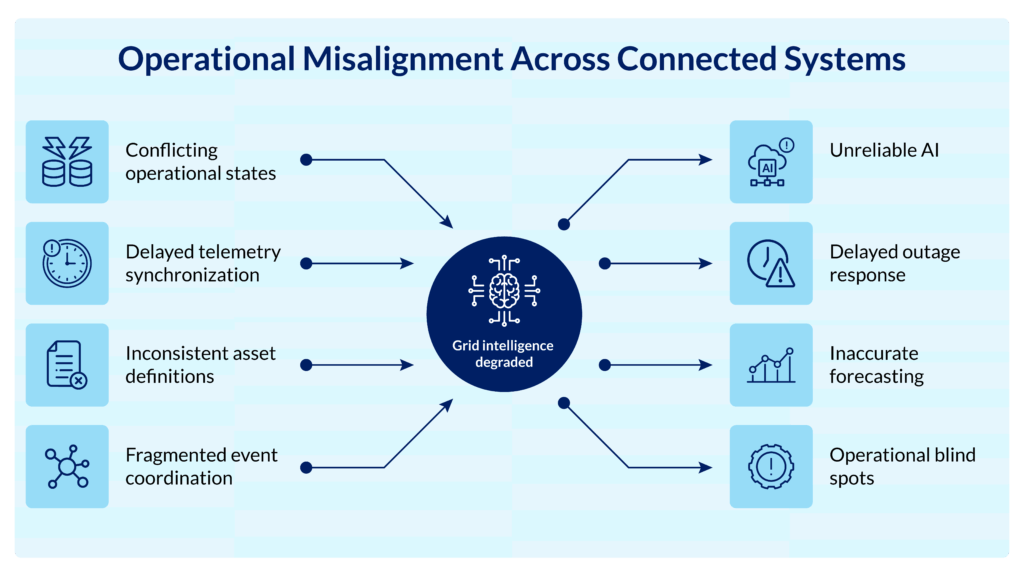
Utilities scaling AI without solving operational synchronization are increasing the likelihood of slower outage coordination, unreliable operational forecasting, and inconsistent grid intelligence across the enterprise.
Utilities that fail to synchronize operational context eventually force AI systems to operate inside conflicting versions of the grid.
The Four Operational Data Layers Utilities Must Coordinate
Effective AMI IoT operational data strategies depend on coordinating four interconnected operational data layers. Weakness in any one layer reduces the quality of utility operational intelligence, limiting the ability of AI systems to deliver reliable insights and recommendations during live grid operations.
Most utility environments operate across four independent operational layers. AI becomes unreliable when those layers evolve separately.
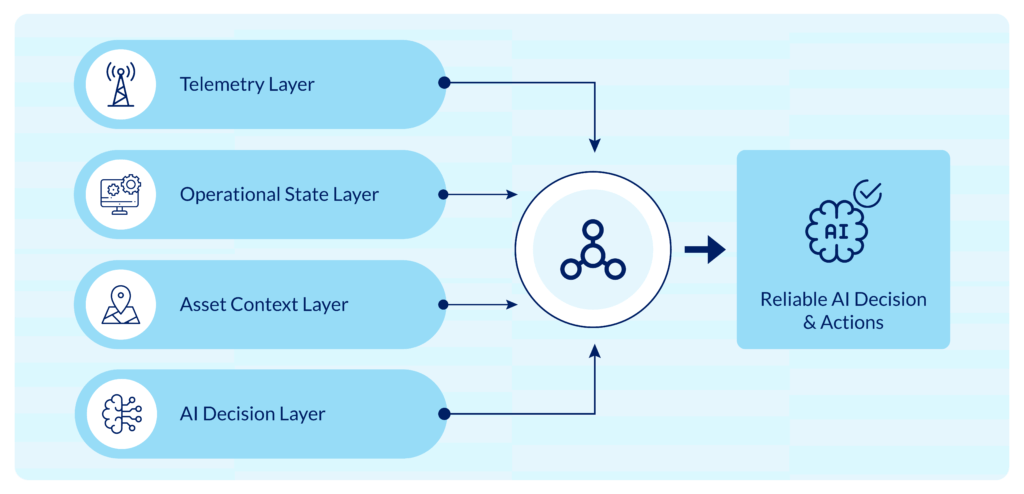
Telemetry Layer
The telemetry layer includes AMI systems, IoT sensors, DER telemetry edge infrastructure, and substation monitoring environments responsible for generating continuous operational signals across the grid.
Many utilities already collect enough operational telemetry to support advanced AI initiatives. The legacy operational architecture underneath the telemetry remains the actual modernization constraint. Telemetry streams frequently lack synchronized operational context across systems, which weakens operational visibility during live grid events.
Operational State Layer
The operational state layer includes OMS SCADA DERMS outage workflows and dispatch coordination systems responsible for interpreting live grid conditions during outages, switching events, DER fluctuations, and operational escalations.
When legacy operational environments evolve independently, utilities struggle to maintain synchronized grid visibility across modern utility operations.
Asset Context Layer
The asset context layer includes GIS platforms, EAM systems, network topology environments, and asset hierarchy structures responsible for maintaining operational relationships across the grid.
Many utilities still manage these environments independently. As a result, the same transformer can appear with:
- Different identifiers
- Conflicting feeder relationships
- Inconsistent maintenance histories
- Disconnected operational dependencies
AI systems frequently inherit these inconsistencies and amplify them across forecasting automation and operational decision-making.
Utilities that are attempting to unify AMI, OMS, GIS, and IoT environments increasingly require coordinated operational platforms rather than isolated integrations. Modern utilities are increasingly modernizing fragmented operational environments through cloud-native enterprise platforms capable of maintaining synchronized operational context across AMI IoT GIS and operational systems.
Decision Layer
The decision layer includes AI models forecasting engines predictive maintenance systems operational automation and grid optimization workflows.
The decision layer performs reliably only when the underlying operational layers remain continuously synchronized.
Most utilities still operate with partial alignment at best.
Utilities are increasingly limited by how fast operational systems can agree on the same version of the grid.
Where Utility Data Integration Breaks Down
Utility operational environments were not originally designed for synchronized AI execution.
Many legacy operational environments still rely on delayed operational updates for fragmented workflows and disconnected operational intelligence models that limit AI execution at scale.
Operational interoperability remains one of the largest barriers to scaling AI reliably across utility environments as distributed energy complexity continues increasing.
Event Latency Across Operational Systems
Operational latency creates one of the largest hidden risks inside utility AI environments.
AMI systems may reflect voltage irregularities immediately, while OMS updates arrive later after operational verification.
That delay creates operational environments where:
- Outage teams work from conflicting system states
- AI models process incomplete operational timelines
- Dispatch coordination slows during high-pressure events
- Predictive systems lose reliability during critical grid conditions
AI systems cannot compensate for conflicting operational timing models.
Conflicting Asset Hierarchies Across Platforms
Utilities frequently operate with inconsistent asset structures across GIS, EAM, field systems, outage platforms, and telemetry environments.
Operational synchronization weakens quickly when systems disagree on:
- Asset ownership
- Network relationships
- Feeder structures
- Operational dependencies
This becomes especially dangerous during outage coordination and DER orchestration, where operational timing and asset context directly influence grid response decisions.
Many utility AI failures originate from operational identity conflicts long before model accuracy becomes the issue.
Batch Architectures Inside Real-Time Grid Operations
Many utilities continue running operational coordination workflows through architectures designed for historical reporting environments.
That model no longer aligns with modern grid demands.
Real-time utility intelligence now depends on event-driven architectures capable of maintaining continuous synchronization and operational observability across systems.
Batch-oriented coordination models are becoming operational liabilities inside increasingly volatile grid environments where utilities are expected to respond in near real time.
Many of these operational failures already stem from fragmented grid intelligence environments where systems operate independently without coordinated synchronization logic. The operational consequences become more severe as AI expands across the enterprise.
Utilities facing these operational gaps are increasingly reassessing fragmented operational environments weaken grid intelligence across the enterprise. The issue extends beyond disconnected systems into larger operational coordination failures.
The Operational Data Architecture AI in Utilities Actually Needs
Many utility organizations focus on expanding AI capabilities before establishing the utility operational architecture required to support them. In practice, AI effectiveness depends on how well operational data flows across utility systems.
A modern utility operational architecture connects AMI, IoT, SCADA, OMS, GIS, EAM, DERMS, and field systems through a shared operational data layer. Rather than relying on isolated integrations, leading utilities are adopting event-driven architectures that continuously synchronize operational state across systems.
This architecture typically includes:
- Real-time telemetry ingestion from AMI and IoT environments
- Event-driven processing across operational systems
- Unified asset context spanning GIS and EAM platforms
- Streaming and historical data convergence
- Grid observability and operational monitoring
- Lakehouse platforms that support AI and analytics workloads
Together, these capabilities strengthen utility data integration across the grid and operational systems. Instead of relying on isolated applications, utilities can establish a continuously synchronized operational environment that improves real-time grid visibility, enhances utility operational intelligence, and enables scalable AI execution.
How Modern Utilities Build AI-Ready Operational Architectures
Utilities leading AI operationalization are redesigning operational coordination models first.
The priority is shifting from centralized data environments toward synchronized operational intelligence.
Event-Driven Operational Architectures
Modern utility environments increasingly rely on event-driven architectures capable of coordinating telemetry updates, outage events, operational workflows, asset changes, and AI execution triggers in real time.
Utilities delaying interoperability modernization are increasing operational coordination risk underneath expanding AI environments where outage response windows continue shrinking.
Utilities modernizing these environments are also investing heavily in modernized operational coordination layers capable of supporting real-time event orchestration across enterprise systems. Utilities modernizing these environments are increasingly prioritizing application modernization solutions capable of supporting real-time operational coordination across distributed utility systems.
Unified Utility Semantic Models
Utilities cannot scale operational coordination when legacy operational environments maintain inconsistent operational definitions across the enterprise.
Modern architectures increasingly standardize:
- Asset definitions
- Telemetry classifications
- Operational event structures
- Feeder hierarchies
- Network relationships
Without semantic consistency, utilities struggle to maintain reliable outage coordination, operational forecasting, and synchronized grid visibility across systems.
Streaming And Historical Data Convergence
Utilities now require modern operational data environments capable of coordinating real-time telemetry, historical operational intelligence, predictive analytics, and AI execution across the enterprise.
Utilities that cannot coordinate real-time telemetry with historical operational context frequently struggle to operationalize AI consistently across outage response, DER management, and predictive operations.
This convergence is driving modernization toward Lakehouse-oriented operational architectures.
Utilities rebuilding these environments are increasingly prioritizing end-to-end data platform modernization strategies capable of supporting synchronized operational intelligence across streaming and historical utility data environments.
Many utilities are adopting Databricks Lakehouse architectures to unify streaming telemetry, operational events, asset intelligence, and historical grid data within a single environment. This approach strengthens the utility AI data foundation by reducing operational latency, improving data consistency, and enabling real-time grid visibility across critical utility systems.
Operational Observability Across Systems
Many utilities discover synchronization failures only after operational coordination slows during outage response or high-demand grid events.
Utilities need continuous visibility into:
- Synchronization health
- Telemetry consistency
- Workflow coordination
- Operational latency
- Event sequencing
Without operational observability fragmented operational environments continue slowing utility environment modernization and AI operationalization efforts underneath the surface.
A Practical Framework for Unifying AMI, IoT, and Operational Data
Most utilities already have enough operational data to support AI. The bigger issue is that AMI IoT OMS GIS and operational systems still interpret grid conditions independently.
Prudent helps utilities rebuild operational coordination first by prioritizing end-to-end data platform modernization strategies capable of supporting enterprise-scale AI execution across utility operations.
Step 1 — Standardize Operational Events
Most utility systems still classify outages, telemetry alerts, switching events, and operational escalations differently across AMI, OMS, SCADA, and IoT environments.
That creates:
- Conflicting operational timelines
- Synchronization drift
- Inconsistent grid visibility
- Unreliable AI outputs
Utilities need standardized event structures capable of maintaining a consistent operational state across systems in real time.
Step 2 — Build A Unified Asset Context Layer
Many utilities still manage asset intelligence separately across GIS, EAM outage systems, and telemetry environments.
The same transformer often appears with:
- Different IDs
- Conflicting feeder structures
- Inconsistent maintenance histories
- Disconnected operational dependencies
Utilities operationalizing AI successfully create centralized asset context layers capable of maintaining synchronized operational relationships across systems.
Step 3 — Enable Real-Time Operational Coordination
Legacy operational environments can no longer support the real-time coordination requirements of modern utility operations.
Utilities now require architectures capable of coordinating:
- Telemetry synchronization
- Operational state changes
- Workflow execution
- Cross-System escalations
All in real time. Event-driven operational coordination is becoming foundational for AI-ready utility environments.
Step 4 — Establish Continuous Operational Observability
Most utilities detect synchronization failures only after operational coordination slows during live grid events.
By then:
- Outage visibility weakens
- Dispatch coordination slows
- AI reliability drops
- Operational teams reconcile conflicting records manually
Utilities need continuous visibility into synchronization health, telemetry consistency, workflow coordination, and operational latency.
| Coordination Area | Operational Impact |
|---|---|
| Event Synchronization | Maintains Consistent Grid State |
| Asset Alignment | Improves Outage Visibility |
| Workflow Coordination | Reduces Operational Delays |
| Operational Observability | Detectes Failures Early |
Step 5 — Embed AI Into Operational Workflows
Many utility AI initiatives still operate separately from live operational environments.
AI systems become operationally effective only when integrated directly into:
- Outage response
- Dispatch prioritization
- Predictive maintenance
- DER coordination
- Operational escalation workflows
Utilities gaining long-term advantage are coordinating operational intelligence across AMI, IoT, OMS, GIS, and operational systems in real time before complexity expands faster than operational control.
What Utilities Should Prioritize to Scale Utility AI
Utility operational complexity is increasing faster than most enterprise architectures were originally designed to support.
DER expansion, distributed grid intelligence, electrification pressure, and real-time operational responsiveness are forcing utilities to coordinate significantly larger volumes of operational context continuously across the enterprise.
Environments that already struggle with synchronization today will become substantially harder to stabilize over the next several years.
Operational Visibility before Automation
Utilities attempting large-scale automation without synchronized operational visibility increase execution risk rapidly.
Operational clarity must stabilize before automation expands.
Operational Modernization before AI Complexity
Many utility organizations continue investing heavily in advanced AI capabilities while legacy operational environments remain fragmented underneath expanding AI initiatives.
That sequence creates instability.
Reliable operational coordination consistently outperforms disconnected AI sophistication.
Governance before AI Expansion
Utilities scaling AI without governance maturity frequently struggle with operational inconsistency synchronization, drift pipeline instability and fragmented observability across operational systems.
Governance increasingly determines whether utility AI environments stabilize operationally or compound fragmentation faster than teams can manage it.
This operational instability explains why many utility AI initiatives succeed during controlled pilots but struggle once exposed to live operational complexity across regions systems and grid states.
Utilities already collecting large volumes of operational data are discovering that AI success depends on maintaining a synchronized operational view across systems, assets, and workflows. As operational complexity grows, operational data synchronization becomes a foundational requirement for enterprise-scale AI execution.
Event Coordination before Predictive Optimization
Utilities cannot optimize operations predictively while operational events remain inconsistently coordinated across systems.
Prediction quality depends heavily on operational synchronization maturity underneath the AI environment.
Once operational data is synchronized across AMI, IoT, GIS, OMS, and enterprise systems, the next challenge is turning that unified data into operational decisions.
Explore what utilities can do with unified AMI data and how decision intelligence improves outage response, forecasting, and asset management while strengthening the utility AI data foundation for future AI initiatives.
The Shift Toward AI-Ready Utility Operations
Utilities are no longer competing on data collection maturity. Most already collect enough telemetry to support advanced operational intelligence across the grid.
Utilities that modernize their utility operational architecture today will be better prepared to integrate distributed energy resources, improve outage response, strengthen predictive maintenance, and support future AI initiatives. Building AI-ready utility operations starts with operational data synchronization and a resilient utility AI data foundation, not simply deploying more AI models.
Enterprise architects and utility data teams are still treating operational systems as separate modernization tracks are increasing long-term coordination risk underneath expanding AI environments.
As utilities continue modernizing operational data environments for enterprise-scale AI execution, Prudent is seeing operational coordination become one of the defining factors separating scalable AI environments from fragmented modernization efforts.
The architectures being designed now will determine which utilities can operationalize AI under live grid pressure and which continue expanding operational complexity faster than operational control.
Prudent helps utilities modernize fragmented operational environments through AI-ready data architectures, coordinated operational intelligence, and scalable modernization strategies that support real-time utility operations across AMI, IoT, OMS, GIS, and enterprise systems.
Connect with Our Utility AI Experts