
The Paradox Nobody Talks About
Your SOC processes 50,000+ alerts daily. You’ve invested in SIEM, EDR, NDR, and threat intelligence. Your team works long hours. Yet critical attacks still slip past. This isn’t a visibility problem. It’s an operational architecture problem.
The uncomfortable truth: SOCs drowning in alerts aren’t failing because they don’t see threats. They’re failing because they can’t convert visibility into decisions fast enough.
The Three Operational Realities Destroying SOC Effectiveness
Reality 1: Analysts Are Cognitively Overloaded
The human brain doesn’t operate effectively in a highly critical environment every hour. Let’s assume it can take from 40 to 60 quality decisions. A typical analyst receives 400+ alerts in an 8-hour shift.
The math is impossible: 400 alerts ÷ 40-60 quality decisions = cognitive failure.
What happens:
- Hours 1-2: Careful analysis
- Hours 3-4: Pattern matching dominates
- Hours 5-6: Real threats blend into noise
- Hours 7-8: Alert fatigue leads to dismissals
By the end of the shift, your best analyst has mentally checked out.
Reality 2: High-Risk Signals Lack Pre-Analysis Context
When a genuine threat arrives, it comes stripped of investigation:
- No asset criticality (is this production or test?)
- No user context (service account or lateral movement).
- No threat of intelligence enrichment (known patterns or novels?)
- No behavioral baseline (is this normal?)
Result: An alert that could be triaged in 2 minutes requires 20-40 minutes of investigation. Analysts waste months annually on first-principles analysis.
Reality 3: Alert Quality Degrades with Every New Tool
The typical expansion pattern:
- Year 1: SIEM → 10,000 alerts/day
- Year 2: Add EDR → 25,000 alerts/day (duplicate alerts across platforms)
- Year 3: Add NDR → 50,000+ alerts/day (three platforms contradict each other)
Each new tool was designed for its specific problem and not to integrate seamlessly.
Result: fragmented workflows, conflicting severity classifications, and separate dashboards.
More tools without workflow redesign = exponentially more noise, not better detection.
Now, if you ask, can Behavioral Detection Actually Help?
Yes, but not in the way most organizations implement it. Behavioral detection is powerful, but only when paired with operational redesign. Here’s why:
The Problem with Signature-Only Detection:
- Traditional SIEM focuses on known attack signatures
- Novel attacks (zero-days, custom malware) slip through undetected
- Attackers increasingly evade signature matching through obfuscation
How Behavioral Detection Solves This:
- Detects deviations from baseline (catches novel malware before it acts)
- Identifies lateral movement patterns that signatures miss
- Flags command-and-control traffic even with unknown malware
- Catches insider threats and compromised accounts that look “normal” to signature tools
The Catch: Behavioral detection only works if you’ve first solved alert fatigue. Adding behavioral detection to an already drowning SOC just creates 60,000 alerts instead of 50,000. The fix requires both behavioral detection and the operational principles we’ll outline below.
Why Alert Volume Strategies Fail
Organizations typically respond to alert overload by adding more layers:
- More monitors → more raw data
- More analysts → same burnout rate, just slower
- More tools → more fragmentation
This is like trying to bail out a boat while water pours through a hole in the hull. You’re not fixing the leak; you’re just hiring more people to bail. The real problem isn’t quantity. It’s signal-to-noise ratio and decision velocity.
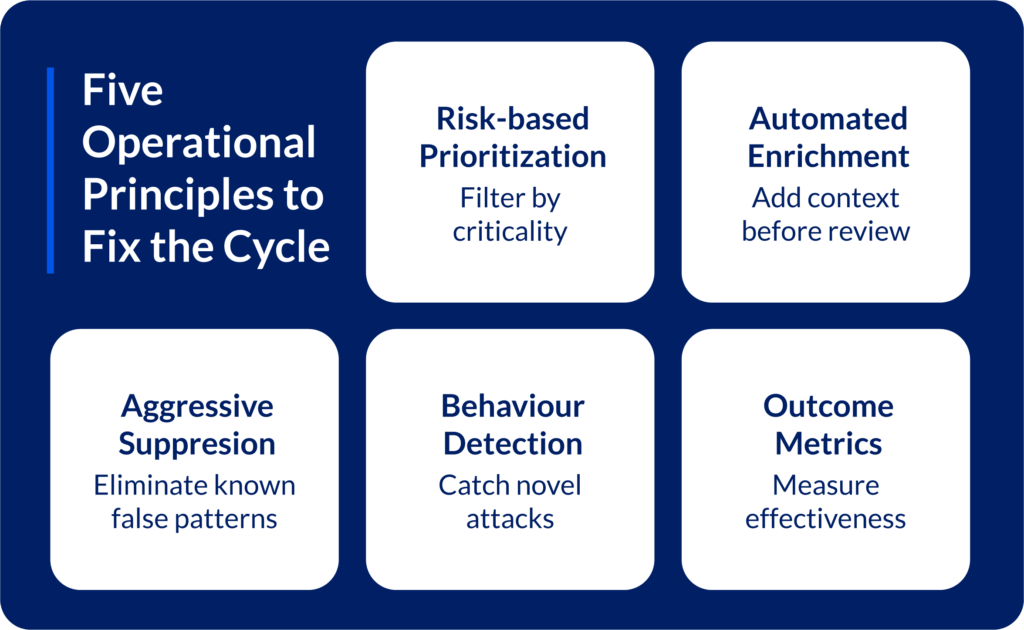
The Operational Fix: Five Principles That Actually Work
Principle 1: Risk-Based Prioritization, Not Volume-Based
Stop treating all alerts equally.
Implement automated risk scoring:
- Score each alert on asset criticality × threat severity × business impact
- Route low-risk alerts to automated response (no human triage)
- Escalate only high-risk alerts to analysts
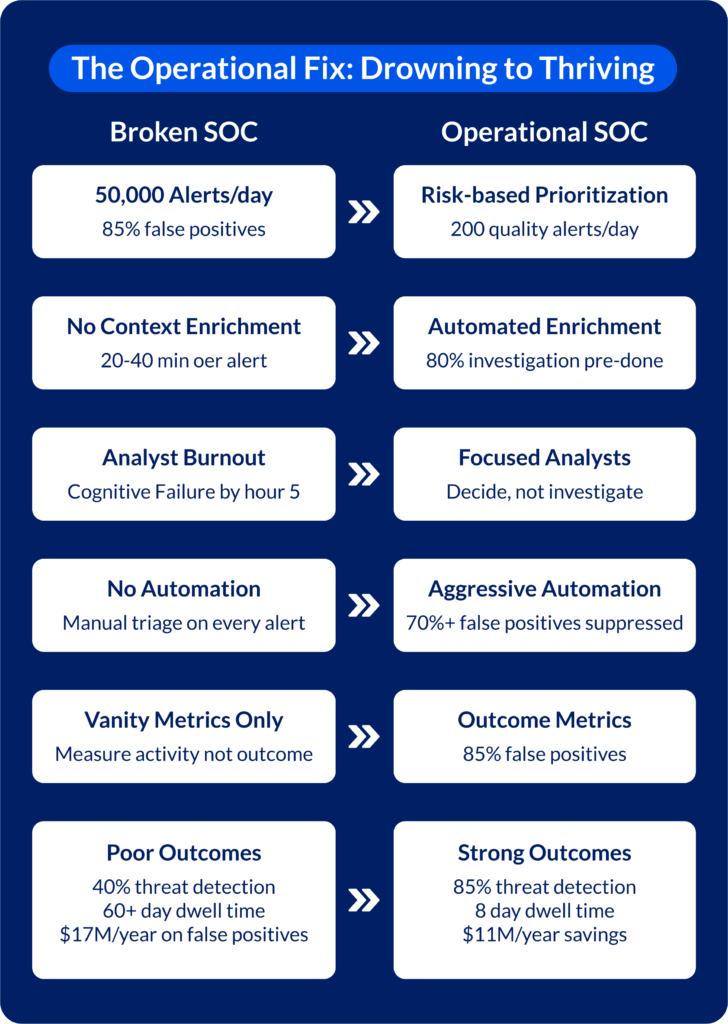
Result: Analysts focus on 200 high-quality alerts instead of 5,000 mixed ones
Principle 2: Automated Enrichment Before Human Eyes
Stop requiring analysts to investigate raw data.
Enrich every alert automatically with:
- Asset intelligence (production criticality, data sensitivity, owner)
- User behavior analysis (is normal for this user?)
- Threat intelligence enrichment (have we seen this signature before?)
- Behavioral baselines (standard deviations from normal)
By the time an analyst sees an alert, 80% of the investigation is complete. They review and decide – not investigate and wonder.
Principle 3: Aggressive False Positive Suppression
Stop letting known benign patterns consume analyst time.
Automate:
- Signature-based suppression (suppress alerts matching known legitimate activity)
- Behavioral baselines (exclude normal patterns automatically)
- Time-of-day filtering (suppress predictable maintenance windows)
- Known service account activity (auto-whitelist routine activity)
Organizations that suppress 70%+ of false positives see analyst productivity jump 300%.
Principle 4: Behavior-Based Detection Alongside Signatures
Signature-based detection caught yesterday’s attacks. Behavioral detection catches today’s novel attacks.
Shift to behavior-based approaches:
- Anomaly detection flags deviations from baseline (catches new malware)
- User entity behavior analytics (UEBA) detects lateral movement patterns
- Network traffic analysis (NTA) identifies command-and-control even with unknown malware
This catches attacks that evade signature matching – the attacks that currently go undetected.
Principle 5: Measure Outcomes, Not Activity
Replace vanity metrics with operational reality metrics:
Stop measuring:
- Alerts processed (activity, not effectiveness)
- Tickets closed (effort, not impact)
- SLA compliance (speed, not quality)
Start measuring:
- Mean Time to Detect (MTTD): How fast from attack to detection?
- Mean Time to Respond (MTTR): How fast from detection to containment?
- Dwell Time: How long do attackers stay inside?
- False Positive Rate: How much time is wasted on noise?
- Threat Detection Rate: What % of real attacks do we catch?
A SOC that detects 500 alerts with 85% accuracy is dramatically more effective than one detecting 50,000 alerts with 10% accuracy – even though activity metrics suggest otherwise.
The Operational Shift: From Monitoring to Decision Making
This isn’t a tool problem. This is an operating model problem.
Effective SOCs operate as decision centers, not monitoring centers.
| Traditional SOC | Operational SOC |
|---|---|
| Monitor everything | Understand the critical |
| Analysts investigate raw data | Systems gather context; analysts decide |
| Escalate to incident response | Execute response during detection |
| Quarterly rule tuning | Continuous daily improvement |
| 90% time on noise | 70% time on genuine threats |
Why Legacy SIEM Platforms Create Alert Overload (And What Modern SOCs Do Differently)
Most organizations are still running SOCs on 15-year-old SIEM architecture. Here’s why that’s a disaster:
Legacy SIEM Problems:
- Designed for Detection, Not Decision Making – Legacy SIEMs were built to forward logs and fire rules. They weren’t architected to enrich, suppress, or contextualize at scale.
- Siloed Tools, No Integration – Your SIEM doesn’t talk to your EDR. Your EDR doesn’t talk to your NDR. You’re manually correlated across three separate consoles.
- Tuning Debt – Rules accumulate. Nobody removes old ones. Signal degrades exponentially.
- No Behavioral Baseline – Can’t tell normal from anomalous because the system has no concept of baseline behavior.
What Modern Platforms Do Differently:
- Unified Alert Ingestion – One pane of glass that understands duplicate alerts and correlates them into single events
- Built-in Enrichment – Every alert is automatically enriched with asset, user, and threat intelligence context
- Behavioral Baselines – System learns what “normal” looks like for each asset and user
- Integrated Response – Detection feeds directly into incident response workflows
- False Positive Suppression Rules – Automatically suppress known benign patterns at scale
When Choosing a Platform to Reduce Alert Fatigue, Evaluate:
- Can it dedicate alerts across multiple tools?
- Does it enrich automatically, or do you need a SOAR?
- How much manual tuning does it require?
- Can it suppress false positives automatically?
- Does it integrate with your existing tools or force rip-and-replace?
The Business Case: The Hidden Cost of Alert Overload
A false positive requiring 30 minutes of analyst investigation costs:
- Direct: 30 min × $75/hour = $37.50
- Context switching: 10 min reorientation = $12.50
- Fatigue accumulation: 1% toward burnout = $5
- Opportunity cost: 30 min not on proactive work = $25
- Total per false positive: ~$80
If your SOC processes 1,000 alerts/day with 85% false positive rate:
- 850 false positives/day × $80 = $68,000/day
- Annualized = $17M/year spent on noise
Organizations that reduce false positives from 85% to 30%:
- Save $11M annually on analyst time
- Improve MTTD by 40%
- Improve MTTR by 60%
- Reduce dwell time by 70%
- Increase threat detection rate from 40% to 85%
This is a business transformation, not an optimization.
The Path Ahead: Your Operational Checklist
1. Audit your alert volume:
How many alerts per day?
What’s your false positive rate?
2. Measure analyst time:
Track time spent on investigations vs. triage vs. novel analysis
3. Implement risk scoring:
Route alerts based on impact, not just detection
4. Automate enrichment:
Build context before human review
5. Suppress known benign patterns:
Eliminate predictable noise immediately
6. Shift metrics:
Replace activity metrics with outcome metrics
7. Integrate response:
Connect detection and incident response workflows
The SOC that escapes alert overload isn’t the one with the most tools. It’s the one that optimizes its operating model – how decisions are made, how context flows, and how automation handles repetitive work.
The Real Question
The question isn’t whether you can handle more alerts.
The question is:
Can your analysts make better decisions with the data you already have?
If the answer is no, adding more tools won’t help.
Your operating model requires a redesign.
The difference between drowning SOCs and thriving ones isn’t tools.
It’s an operational architecture.
Don’t add more volume. Fix the signal.