
Banks won’t say this publicly but are already internally aware.
This decision integrity problem stays invisible during daily operations and only surfaces when something significant breaks such as a regulatory examination, a failed transformation programme, a board-level audit that asks questions the data estate cannot cleanly answer.
This piece explores how data silos in banking produce misaligned decisions, why standard integration investments haven’t resolved it, what it costs institutions at the strategic level, and what breaking down data silos genuinely demands.
Data Silos as a Governance Failure in Banking
Data silos were classified as an IT maintenance issue for years. That classification is no longer accurate.
When fragmented data architecture produces structurally different outputs for the same customer, the same transaction, the same risk position, the organization is not operating with one version of reality. It is operating with several versions simultaneously.
How Fragmented Data Architecture Produces Misaligned Business Data
Core banking, CRM, risk engines, and compliance databases each evolved to own their domain. None was designed to share a consistent definition of critical business entities across the enterprise. The result:
- Relationship management operates from one version of the customer
- Credit risk models run on a different version of the same customer
- Compliance validates that customer against a third
None of these versions are wrong. None of them are complete. Decisions made across these functions are not data-driven in any coherent sense, but they are the product of fragmented inputs presented as aligned outputs.
Why Siloed Customer Data Carries the Highest Consequences in BFSI
A retailer with siloed inventory data loses operational efficiency. A bank with siloed customer data makes incorrect credit decisions, files inconsistent regulatory reports, and builds AML models on incomplete risk profiles.
The exposure compounds quietly normalized into daily workflows, absorbed by workarounds until an external examination strip away the layers.
The Real Impact of Data Silos
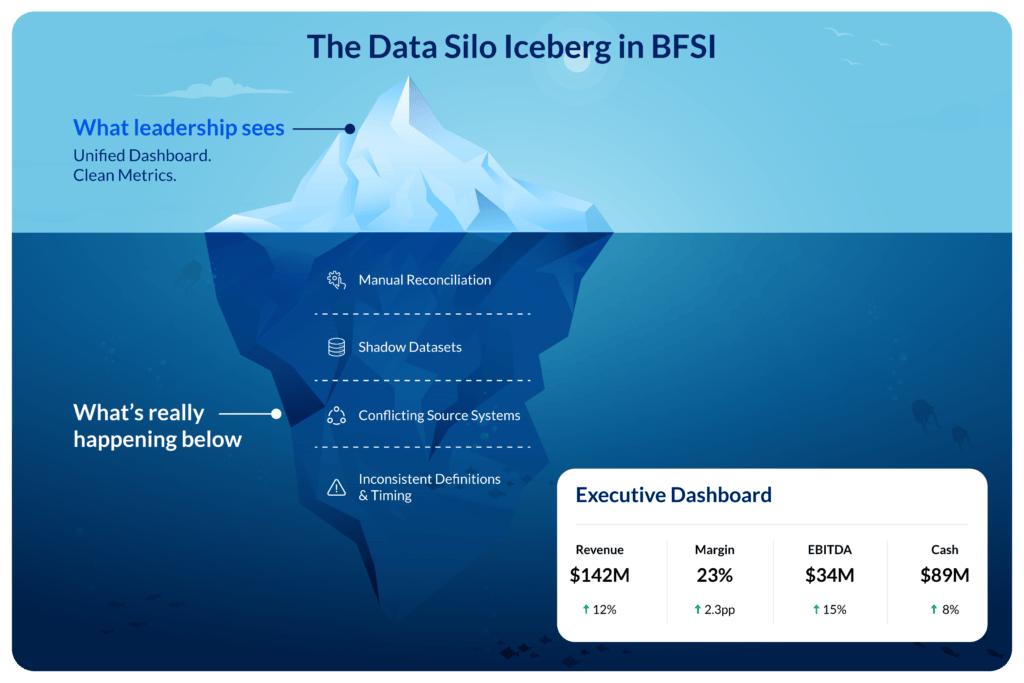
Inside most large banks, data teams run manual reconciliation before every board report. Parallel pipelines correct what official systems produce. Shadow datasets persist because analysts know source systems disagree.
Leadership sees the final report. They do not see the reconciliation infrastructure that produced it, or how much analytical capacity is consumed maintaining it.
By the time data inconsistency becomes visible at the executive level, it has already compromised months of operational decisions downstream.
Conflicting Customer Profiles Across Credit, Risk and Compliance
When a customer applies for a credit facility, their profile exists simultaneously across core banking, CRM, the risk engine, and the KYC platform, each reflecting different update cycles, different business rules, different ownership.
The underwriter references one version. The risk model runs on another. Compliance validates against a third. The decision that emerges is not analytically sound. It is a negotiation between incomplete, misaligned data fragments.
Why Regulatory Reporting Discrepancies Stay Hidden Until Examination
Data fragmentation does not announce itself during daily operations. It announces itself during regulatory examination, at which point options are limited, and costs are significant.
- Discrepancies managed quietly internally become formal supervisory findings
- Reconciliation gaps treated as routine overhead become Matters Requiring Immediate Attention
- Manual correction layers that passed internal review fail under external scrutiny
Reducing this exposure structurally through pipeline-first data reliability rather than manual reconciliation is precisely what our Data Engineering Services addresses at the foundational level.
How Data Silos Stall Enterprise Transformation Programmes
Ask any CDO who has led a Customer 360 or enterprise AI initiative how early they hit a data alignment problem.
The answer is always the same. Earlier than planned, more expensively than budgeted.
When functions operate from different versions of business truth, every cross-functional programme becomes a data remediation project before it becomes a strategic one.
Data Integration Challenges in Banks
Build a data warehouse. Create a data lake. Deploy MDM. Most large banks have done all of this but still have data silos.
The investment is not the problem. The assumption behind it is.
Centralization addresses where data lives. It does not address how data is defined, owned, trusted, and governed across a federated enterprise.
Why Legacy Core Banking Systems Were Not Designed for Enterprise Data Consistency
Core banking platforms built 15 to 20 years ago were designed to own their domain and not share a consistent view of it across the enterprise. Each function operated independently. Cross-functional data alignment was not a design requirement.
| System | Data Domain Owned | Why It Creates Silos |
|---|---|---|
| Core Banking Platform | Credit and account data | Owns customer financial identity independently of other systems |
| Treasury System | Liquidity and funding positions | Operates on separate update cycles from risk and reporting systems |
| Payments Infrastructure | Transaction history | Records transactions without cross-referencing customer risk profile |
| Risk Engine | Exposure and loss models | Calibrated on internal data cuts that may not match compliance view |
| KYC / AML Platform | Customer due diligence | Maintains separate customer profile not linked to CRM or core banking |
Why Data Centralization Does Not Resolve Decision Misalignment
Investment in data storage and access has outpaced investment in decision alignment. Banks have scaled data availability not decision consistency.200
This bias is visible in market spend. The global banking data lake platform market is projected to grow from $6.8B in 2024 to $67.8B by 2034 (source: scoop.market.us).
Yet decision inconsistency persists across systems, functions, and regulatory contexts because centralization improves access, not decision logic.
Until alignment is engineered at the decision layer, integration challenges will persist regardless of infrastructure investment.
The Business Cost of Misaligned Decisions
The cost of data silos in banking does not appear on any standard performance dashboard. It accumulates across dimensions most institutions are not measuring directly:
| Cost Dimension | How It Manifests | Business Impact |
|---|---|---|
| Analyst capacity | 30–40% consumed by reconciliation rather than analysis | Data talent delivers a fraction of its potential value |
| Risk model accuracy | Models calibrated on structurally incomplete data | Credit and market risk decisions carry unquantified model error |
| Regulatory exposure | Findings that were architecturally avoidable | Remediation costs that far exceed prevention |
| Transformation failure | Programmes stalled by data remediation before strategy begins | Technology investment unable to deliver ROI |
| Talent attrition | Senior data professionals unwilling to spend careers on reconciliation | Difficulty retaining modernization capability |
Decision Latency as a Competitive Disadvantage in Modern Banking
Credit approval lags are not caused by complex decisions, but by the need to reconcile fragmented data across systems, teams, and definitions.
While your competitors execute in real time, you might operate on delayed alignment:
- Data must be validated across sources
- Definitions must be reconciled across functions
- Context must be rebuilt before action
What appears as “processing time” is actually decision reconstruction.
This delay impacts credit turnaround, risk response, customer experience, and regulatory accuracy simultaneously.
The architecture either outputs decision or forces alignment before action.
AML and Compliance Risk from Disconnected Data Systems
Batch-dependent pipelines mean transaction patterns requiring immediate AML review may not appear in compliance reporting for 24 to 48 hours. Risk models built from fragmented profiles carry structural blind spots from inception and not introduced later.
Analytics & BI Services built on a governed, integrated foundation and not a reconciled one that give compliance teams earlier detection, consistent audit trails, and decision inputs that hold under regulatory scrutiny.
Breaking Down Data Silos
What a Unified Data Strategy Actually Requires
The current question in most institutions: where should data live? The correct question: how does data need to flow to support consistent, aligned decisions across a federated enterprise?
That reframe changes what success looks like from storage consolidation to decision alignment.
From Isolated Data Repositories to Enterprise Data Integration
| Commitment | What It Requires | What It Prevents |
|---|---|---|
| Semantic consistency | Shared definitions across source systems before consolidation | Conflicting entity definitions producing structurally different outputs |
| Governance at the data layer | Data controls as structural architecture, not downstream functions | Manual reconciliation becoming the primary reliability mechanism |
| Integration as business capability | Enterprise-level ownership, not IT maintenance | Point-solution proliferation that adds connectivity without alignment |
| Decision-based measurement | Infrastructure measured by reliability and time-to-insight | Investment that improves storage but not decisions |
How Data Platform Modernization Enables Decision-Ready Architecture
The institutions making meaningful progress have not found a better platform. They have redefined what the data function is responsible for delivering not data, but decision capability.
End-to-End Data Platform Modernization executed with genuine architectural intent delivers what infrastructure investment alone cannot:
- Credit decisions faster, internally consistent, and defensible under regulatory examination
- Regulatory submissions that withstand examiner scrutiny without manual correction layers
- A governed data foundation that makes AI, advanced analytics, and Customer 360 viable and not perpetually aspirational
- Data engineering capacity redirected from reconciliation maintenance to actual value creation
A single source of consistent data is a governance achievement requiring architecture designed around decisions from the outset, not added around systems never built to support them.
The Bottom Line
Data silos in banking are not a legacy problem the next platform investment will resolve. They are an active strategic liability compounding through every credit decision on an incomplete profile, every regulatory submission built on manually reconciled data, every transformation programme that stalls on fragmented foundations.
Decision alignment is not a byproduct of better pipelines. Institutions that design their architecture around it will be the ones that finally extract value from the systems they have already built.
Build Decision-aligned Data Architecture with Prudent
A decision-aligned foundation delivers consistent outputs, faster execution, and defensible regulatory outcomes.
Prudent’s enterprise data specialists work with financial institutions to identify precisely where fragmentation is undermining decision quality and what it will take to resolve it architecturally.
Start aligning your data architecture with decision outcomes today