The Compliance Test That Missed the Breach
In September 2023, a manufacturing enterprise completed its annual penetration test. The engagement covered the agreed scope, external perimeter, key internal systems, and the corporate network. The report rated the organization’s security posture as satisfactory. Three critical findings were identified and logged for remediation.
Six weeks later, a threat actor exploited a misconfigured cloud storage bucket that had been provisioned after the pen test window closed. The bucket was not in scope because it did not exist when the scope was agreed. It had never been assessed. It was not in the asset register. The SOC had no detection rule for access patterns associated with that asset class.
The data exfiltration ran for 19 days before a third-party notification triggered an investigation.
The penetration test was not wrong. It was simply a photograph of a building that had already been extended. The photograph was accurate. It just did not show the new wing, and that is where the adversary entered.
This is the fundamental limitation of point-in-time security testing in dynamic enterprise environments. Attack surfaces change continuously. Penetration tests do not. The gap between those two realities is where breaches happen, not in the systems that were tested, but in the systems that were not.
What a Penetration Test Actually Measures, And What It Does Not
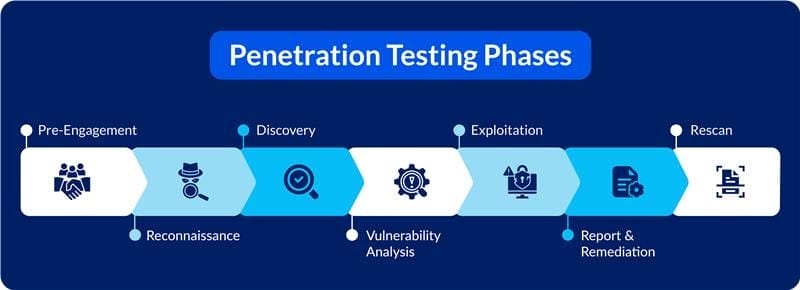
Penetration testing is a deliberately bounded exercise. A team of security professionals, working within an agreed scope and timeframe, attempts to exploit vulnerabilities in a defined set of systems. The output is a report that describes what was found, how it was exploited, and what should be fixed.
That is genuinely valuable. Penetration testing surfaces real vulnerabilities, validates control effectiveness, and provides evidence of security posture for compliance and governance purposes. Organizations that do not conduct penetration testing are operating with significantly less visibility into their exploitability than those that do.
But penetration testing has structural limitations that become critical at enterprise scale:
- Scope is negotiated, not comprehensive: The attack surface assessed in a penetration test is the attack surface agreed upon before the engagement begins. Shadow IT, recently provisioned assets, new integrations, and undocumented systems are outside scope, and are frequently where adversaries find their entry points.
- Time is fixed, environments are not: A penetration test reflects the environment on the days it was conducted. In enterprises where dozens of infrastructure changes occur weekly, a report that is three months old is describing a materially different environment.
- Findings inform remediation, not detection: The output of a penetration test is a remediation list. It tells the security team what to fix. It does not tell the SOC what to watch for and the gap between fixing a vulnerability and detecting its active exploitation is where incidents become breaches.
- Coverage is human-constrained: The depth of a penetration test is bounded by the hours purchased. Testers make decisions about where to focus based on experience and prior findings. Novel attack paths, low-signal exposures, and long-tail risks are frequently under-tested.
A penetration test answers the question: can we be breached through these systems, assessed this way, on these dates? A continuous vulnerability program answers a different question: what is exploitable right now, across everything we operate, and is our SOC armed to detect it?
Also Read: How Legacy SOC Architecture Is Failing Enterprise Security
The Architecture Gap Between Vulnerability Management and SOC Detection
In most enterprises, vulnerability management and SOC detection operate as parallel but disconnected functions. The vulnerability management team scans for exposures and produces remediation backlogs. The SOC monitors for active threats and responds to alerts. Both functions exist. Neither is informed by the other in real time.
The operational consequence of this separation is a detection blind spot that is directly proportional to the organization’s unpatched exposure. Every vulnerability that is known to the vulnerability management team but unknown to the SOC is a gap where an adversary can operate without generating a detection-relevant signal.
Three ways the gap manifests operationally
1. The SOC detects exploitation of vulnerabilities it did not know existed – A threat actor exploits a known CVE on a production system. The SOC has a generic detection rule for that exploit pattern, but the rule is not tuned to the specific asset topology – the lateral movement that follows goes undetected because the SOC did not know the path was traversable.
2. Remediation is prioritized by severity, not by exploitability in context – Without SOC input, vulnerability teams prioritize remediation by CVSS score. Critical scores get patched first. But a medium-severity vulnerability on a system directly reachable from an exposed external service may represent more actual risk than a critical vulnerability on an air-gapped internal system and CVSS score alone does not capture that.
3. New assets enter the environment without entering SOC scope – Cloud provisioning, SaaS onboarding, and third-party integrations add systems to the attack surface continuously. In organizations where asset discovery is periodic rather than continuous, new assets operate for weeks or months without appearing in the SOC’s monitoring scope.
The core problem: Vulnerability data and detection capability are most valuable when they inform each other in real time. When they are separated into distinct workflows with no integration, the organization has better visibility into its exposure than its SOC has into its detection coverage and adversaries exploit exactly that gap.
What a Continuous Vulnerability Program Actually Is
A continuous vulnerability program is not a penetration test run more frequently. It is a fundamentally different operating model, one that treats attack surface exposure as a live data feed rather than a periodic snapshot and integrates that feed directly into SOC detection.
The program has four operational components that distinguish it from traditional vulnerability management:
Continuous asset discovery
Every asset in the enterprise environment, including cloud workloads, SaaS integrations, shadow IT, and third-party connections is identified and inventoried on a continuous basis. New assets are detected within hours of provisioning, not weeks or months. The asset register is a live document, not an annual audit artifact.
Persistent exposure monitoring
Vulnerability scanning runs continuously across the full asset inventory, not on a quarterly schedule. New CVEs are assessed against the current asset register within hours of publication. Configuration drift, assets that were compliant last week and are not today is detected as it occurs. The exposure posture is always current.
Threat-informed prioritization
Remediation is prioritized not by CVSS severity score alone, but by the intersection of three factors: how exploitable the vulnerability is in the current environment, how critical the affected asset is to business operations, and whether threat intelligence indicates that active adversaries are currently targeting that vulnerability class. A medium-severity CVE being actively exploited by a threat actor targeting your sector ranks higher than a critical CVE with no known active exploitation.
Bidirectional SOC integration
The continuous program does not end with a remediation backlog. Every significant finding, new exposed asset, critical unpatched CVE, newly identified attack path, is fed directly into the SOC as detection-relevant context. The SOC in turn feeds active detections back into the vulnerability program, surfacing new exposure that scanning alone would not identify.
The difference between a vulnerability program and a continuous vulnerability program is not cadence. It is architecture. One produces reports. The other produces a live detection input.
How Continuous Programs Feed SOC Detection: The Integration Architecture
The diagram below maps how the four layers of a continuous vulnerability program connect to the SOC detection model and where the closed-loop feedback between detection and discovery creates a compounding security posture over time.
What the continuous program feeds into SOC detection
The integration is not a one-way data transfer. Each output from the continuous vulnerability program changes something specific in the SOC’s detection postureand each SOC detection surfaces new information that the vulnerability program acts on.
| Continuous program output | How it reaches the SOC | What the SOC gains |
|---|---|---|
| Newly discovered exposed asset | Asset added to SOC monitoring scope automatically | Coverage gap closed: SOC now monitors what it did not know existed |
| Critical unpatched CVE on production system | SOC detection rule elevated for exploit patterns targeting that CVE | Pre-armed detection: SOC knows the likely attack vector before it is used |
| New attack path identified between systems | Lateral movement detection rules updated for that specific path | Detection tuned to the actual environment topology, not generic movement patterns |
| External exposure of internal service | Alert raised in SOC; external monitoring rule added immediately | Exposure detected and monitored before threat actors discover and index it |
| Remediation confirmed on previously flagged asset | Detection rule adjusted; risk score updated in SOC platform | Risk model reflects current state: SOC is not chasing already-fixed issues |
Five Scenarios: The Same Exposure, Two Outcomes
The operational difference between a penetration test program and a continuous vulnerability program is most visible in the scenarios where the penetration test is structurally unable to help. Each case below reflects a documented enterprise security failure pattern.
| Scenario | With pen test only | With continuous vulnerability program |
|---|---|---|
| New cloud workload deployed mid-year | Outside scope never assessed. Misconfiguration persists for months. | Discovered within hours of deployment. Misconfiguration flagged and triaged before first external connection. |
| Critical CVE published for in-use software | SOC has no visibility into which internal assets are exposed. Patching is ad hoc. | Exposed assets identified within hours. SOC detection rule elevated. Patch prioritized by asset criticality. |
| Adversary exploits a known unpatched vulnerability | Vulnerability was in last year’s pen test report. Never remediated. No detection rule existed for the exploit pattern. | Vulnerability tracked in continuous programs. SOC had a detection rule for exploiting behavior. Alert raised at first probe. |
| Third-party integration introduces new attack path | Vendor connection added after pen test window. No assessment ever conducted on the integration. | Continuous discovery identifies the new integration. Attack path modeled. SOC alerted to monitor lateral movement from that vector. |
| Internal tool exposed to internet by misconfiguration | Not in scope — internal tools excluded from external pen test. Exposure undiscovered. | Continuous external attack surface monitoring detects exposure within minutes. Remediated before indexed by threat actors. |
In every scenario, the penetration test did not fail because it was conducted poorly. It failed because it was the wrong tool for a dynamic problem. The continuous program is not a better penetration test, it is a different capability designed for a different threat model.
Building the Program: What Enterprise Security Architects Do Differently
Security architects who have built functioning continuous vulnerability programs describe the transition as a change in the fundamental question the security function is trying to answer. The question shifts from ‘what did the pen test find?’ to ‘what is exploitable right now, and does our SOC know about it?’
That question change drives a different set of architectural decisions:
Asset discovery precedes everything else
You cannot assess what you do not know exists. The first architectural investment in a continuous program is always a discovery capability that covers the full environment, including cloud accounts, SaaS platforms, subsidiary networks, and third-party integrations. Organizations that skip this step build vulnerability programs on an incomplete asset register and inherit all its blind spots.
Prioritization is a risk model, not a score
Mature programs replace CVSS-score-based prioritization with a risk model that factors in asset criticality, network reachability, active threat actor targeting, and time-to-exploit. The output is not a list ranked by score, it is a risk-weighted remediation queue where the items at the top are the ones most likely to be exploited in a way that causes material damage before they can be patched.
SOC integration is designed at program inception, not added later
In organizations where continuous vulnerability programs were retrofitted onto existing SOC architectures, the integration is typically incomplete and manual. In programs that were designed with SOC integration as a first-class requirement from the start, findings flow into detection rules automatically, new assets enter SOC monitoring scope on discovery, and the risk model is shared between both functions.
The program owns a closed feedback loop
A continuous vulnerability program without feedback from the SOC is still a one-directional data flow. Mature programs incorporate SOC detection data as a discovery input, active exploitation attempts surface exposure that scanning did not find, anomalous lateral movement patterns reveal attack paths that were not modeled, and threat intelligence about active adversary TTPs adjusts the prioritization model in near real time.
Security architects who have made this transition consistently report the same observation: the most valuable output of integrating the vulnerability program with the SOC is not the detection improvements, it is the discovery improvements. The SOC sees things the scanner cannot.
The Maturity Model: Where Most Organizations Are and How to Move
Most enterprises sit at Stage 1 or Stage 2 of vulnerability program maturity, compliance-driven, periodic, and disconnected from SOC detection. The table below maps each maturity stage against its vulnerability posture, SOC integration, and resulting detection capability.
| Stage | Vulnerability management posture | SOC integration | Detection capability |
|---|---|---|---|
| Stage 1 | Annual pen test, compliance-driven | None: findings never reach SOC | Reactive: SOC detects only known signatures |
| Stage 2 | Quarterly scanning + annual pen test | Manual: high-severity findings occasionally shared | Partial: some exposure context, no systematic feed |
| Stage 3 | Continuous scanning + asset discovery | Structured: findings feed into SOC triage queue | Improving: detection rules updated from exposure data |
| Stage 4 | Continuous program + attack surface management | Bidirectional: SOC and vulnerability data share context | Anticipatory: SOC pre-arms for exposure before exploitation |
| Stage 5 | Continuous program + threat-informed prioritization | Unified: single risk model drives both detection and remediation | Predictive: detection tuned to active threat actor TTPs targeting exposed assets |
The progression from Stage 1 to Stage 5 is not primarily a technology investment. It is an architectural decision, and then a governance decision about who owns the integration between vulnerability management and SOC detection, and what they are accountable for.
The most common stall point: Stage 2 to Stage 3. Organizations add continuous scanning but do not build the SOC integration. The vulnerability program improves but the detection posture does not. Findings accumulate in a remediation backlog while the SOC continues to operate without exposure context. The capability investment is made; the architectural connection is not.
What the Investment Case Looks Like from the C-Suite
For enterprise leadership, the continuous vulnerability program is often framed as a security tool upgrade, a replacement for the annual pen test, or an addition to the scanning stack. That framing consistently undervalues the investment and misaligns the business case.
The correct framing is not tool upgrade. It is detection architecture completion. A SOC that operates without continuous exposure context is a detection system that is structurally blind to a significant category of risk, and that blindness has a measurable cost in dwell time, incident frequency, and breach consequence.
The comparison that clarifies the investment
Detection inputReport delivered weeks after testing by then, environment has changedLive findings feed directly into SOC detection rules and threat modelsScopeBounded by engagement agreed attack surface onlyContinuous across full attack surface including new assets, cloud, SaaSRemediation cycleAnnual findings addressed before next year’s testContinuous findings triaged by exploitability and asset criticality in real timeSOC integrationNone pen test report sits in a separate workflow from detectionBidirectional SOC detections surface new exposure: findings sharpen detectionUnknown asset coverageZero shadow IT and undiscovered assets are outside scope by definitionContinuous discovery identifies assets that were never in the asset registerCompliance valueHigh satisfies audit requirements with a dated reportHigh + operationalsatisfies compliance and drives actual risk reduction
| Dimension | Annual penetration test | Continuous vulnerability program |
|---|---|---|
| Coverage model | Point-in-time snapshot reflects the environment as it was on test day | Persistent reflects the environment as it is right now |
| Detection input | Report delivered weeks after testing, by then, the environment has changed | Live findings feed directly into SOC detection rules and threat models |
| Scope | Bounded by engagement, agreed attack surface only | Continuous across the full attack surface, including new assets, cloud, and SaaS |
| Remediation cycle | Annual findings addressed before next year’s test | Continuous findings triaged by exploitability and asset criticality in real time |
| SOC integration | No pen test report sits in a separate workflow from detection | Bidirectional SOC detections surface new exposure: findings sharpen detection |
| Unknown asset coverage | Zero shadow IT and undiscovered assets are outside the scope by definition | Continuous discovery identifies assets that were never in the asset register |
| Compliance value | High satisfies audit requirements with a dated report | High + operational satisfies compliance and drives actual risk reduction |
Three questions that frame the C-suite decision
- If a new cloud workload was misconfigured and exposed to the internet this morning, how long would it take your SOC to know and does your current vulnerability program change that answer?
- When a critical CVE is published for software you operate, does your SOC automatically know which production assets are exposed or does that connection require manual work that takes days?
- Does your vulnerability remediation backlog reflect what is most likely to cause a material breach, or what has the highest CVSS score?
If any of these questions produces uncertainty rather than a clear answer, the gap between vulnerability management and SOC detection is already a board-level risk,whether or not it has been framed that way.
What Mature Looks Like, and the Starting Point
A mature continuous vulnerability program does not look like an organization that runs more scans. It looks like an organization where the SOC already knows before a threat actor probes the first asset, which systems are exposed, which exposures are being actively targeted by adversaries, and what behavioral signatures to watch for at every stage of a potential exploitation chain.
That capability is the result of an architectural decision to treat vulnerability exposure as a live detection input rather than a remediation backlog. It is available to any enterprise willing to build the integration between the two functions that currently operate in parallel.
The practical starting point
For most enterprises, the highest-value first step is not replacing the annual penetration test. It is building the connection between the vulnerability data they already have and the SOC that is not currently receiving it. That connection automated, bidirectional, and continuously updated is what converts a vulnerability program from a compliance exercise into a detection asset.
The second step is continuous asset discovery: ensuring that the asset register the vulnerability program operates against reflects the actual current attack surface, including cloud, SaaS, and third-party integrations that are outside the scope of traditional scanning.
These two steps do not require replacing the penetration testing program. They require extending it, building the continuous capability that operates between pen test engagements and feeds the SOC with the exposure context it needs to detect exploitation before the next test is scheduled.
The organizations that close the gap between vulnerability exposure and SOC detection are not the ones with the largest security budgets. They are the ones that recognized the gap as an architectural problem and built the integration that closes it.
Working with Prudent
At Prudent, we work with enterprise security teams to build the integration layer between continuous vulnerability programs and SOC detection, mapping current program maturity, identifying where exposure data stops short of the detection architecture, and designing the bidirectional connection that makes both functions materially more effective.
If your organization is ready to move from a vulnerability program that produces reports to one that produces detection inputs, the starting point is an assessment of where your current architecture leaves the SOC operating without exposure context.
The gap is almost always smaller than it appears. And closing it changes more than the detection posture.