
Over 72% of U.S. electric meters are now AMI-enabled. Utilities now process outage events, interval consumption data, transformer loading patterns, switching activity, DER fluctuations, and asset condition signals at a scale grid operations teams were never designed to coordinate manually.
Yet outage restoration still runs over SLA. Field crews still verify alerts across multiple systems before acting. Compliance teams still rebuild reporting data from spreadsheets before submission deadlines. Storm response coordination still depends on disconnected operational systems communicating under pressure.
The issue is operational fragmentation. Most utilities still operate across disconnected OMS, GIS, SCADA, CIS, EAM, and ERP environments with no governed operational truth layer connecting them.
Utilities are losing operational efficiency because operational truth is fragmented across systems that do not align well under real-world pressure.
Every outage delay, restoration bottleneck, dispatch failure, manual reconciliation, and unreliable AI output exposes the same structural weakness: disconnected operational systems generating updates faster than utilities can coordinate them during live grid operations.
This piece breaks down where fragmented utility data is weakening grid reliability, increasing operational strain, slowing restoration coordination, and causing AI integration programs to stall before they reach operational scale.
What Data Silos Actually Cost Utilities
This is the hidden cost structure of utility data silos: the operational damage rarely appears in the budget category where the architectural failure originates.
Instead, the cost surfaces through:
- extended outage durations
- unnecessary truck rolls
- delayed fault isolation
- restoration inefficiencies
- overtime escalation
- compliance reconstruction
- reactive maintenance spending
- declining field trust in operational systems
As utilities expand AI-driven outage prediction, asset monitoring and load forecasting initiatives, fragmented operational data increasingly limits system reliability and model trust across grid operations.
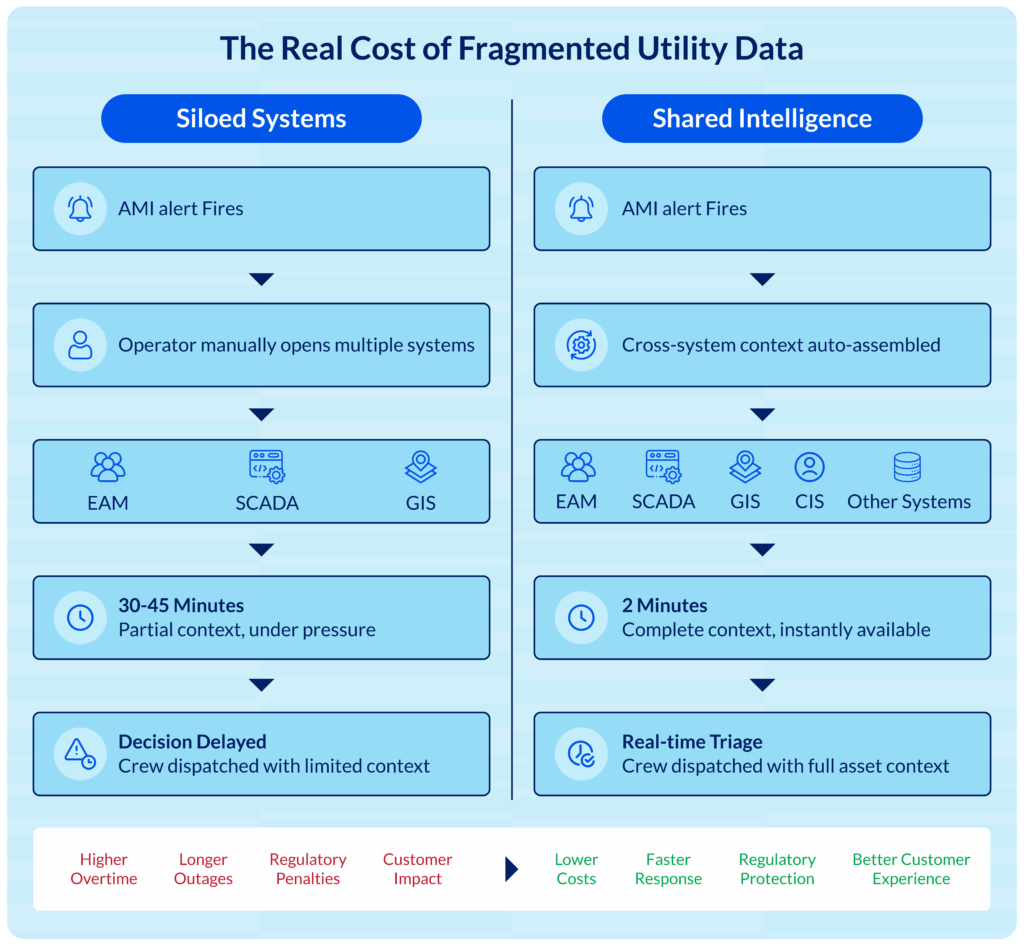
When an AMI alert or predictive maintenance signal requires a field operator to manually cross-reference GIS topology, EAM maintenance history, SCADA load conditions, and outage context before taking action, the operational cost spreads far beyond the original event.
In many utilities, AMI data still operates without the decision intelligence needed to translate raw signals into coordinated operational action.
The impact appears across:
- field overtime
- dispatch coordination delays
- restoration inefficiency
- repeat investigations
- workforce strain
Most utilities underestimate the operational cost of fragmented data because the damage distributes across multiple departments instead of appearing under one accountable owner.
Utilities with stronger restoration coordination and operational consistency share one structural characteristic: they establish governed cross-system data foundations before scaling operational intelligence layers.
Utilities that struggle usually reverse the sequence. They centralize visibility before defining ownership. They connect systems before establishing operational accountability.
The result is predictable:
Operational systems generate signals faster than teams can reconcile them into reliable field decisions.
That gap determines whether operational intelligence becomes embedded into grid execution or quietly bypassed by the people responsible for reliability.
How Fragmented Utility Data Weakens Grid Reliability
Extended Outage Restoration Starts with Incomplete Operational Context
When outage response moves across OMS, GIS, SCADA, and EAM systems without synchronized operational context or shared asset identity, crews dispatch with partial visibility.
Transformer condition data sits inside EAM. Switching configuration remains inside SCADA. Customer impact visibility lives inside CIS. Network topology updates stay isolated inside GIS.
Under outage pressure, operators make restoration decisions across systems that were never designed to reconcile operationally in real time.
The consequences compound quickly:
- delayed fault isolation
- incorrect switching sequences
- repeated dispatches
- slower restoration coordination
- elevated SAIDI/SAIFI exposure.
The incident report often attributes delays to weather severity or infrastructure complexity. The fragmented operational architecture amplifying the disruption rarely gets named directly.
Grid Alert Fatigue Is Becoming a Reliability Problem
An AMI alert identifying abnormal consumption patterns becomes operationally useful only when correlated against:
- asset condition history
- outage activity
- feeder load behavior
- GIS topology
Without that context, field teams receive high-volume alerts with low operational confidence.
Over time, crews adapt accordingly:
They stop trusting the alerts.
The same trust gap increasingly affects AI-driven operational systems deployed across fragmented utility environments.
That erosion of trust becomes one of the least-attributed but most expensive consequences of fragmented operational infrastructure.
| Cost Category | Where the Cost Lands | What Usually Gets Blamed |
|---|---|---|
| Unnecessary truck rolls | Field operations budget | Crew scheduling |
| Delayed fault response | Reliability metrics | Weather complexity |
| Crew overtime escalation | Workforce spend | Staffing shortages |
| Missed maintenance windows | Reactive repair costs | Aging infrastructure |
| Repeated alert investigations | Operations labor | Model accuracy |
None of these costs appear directly inside an architecture review. AMI data alone creates volume. Cross-system operational context creates usable grid intelligence.
Key Insight:
Alert fatigue compounds through outage metrics, overtime escalation, workforce strain, and declining field confidence long before leadership recognizes it as a data architecture problem.
Fragmented Asset Data Creates Regulatory and Capital Recovery Risk
In many utilities, GIS asset records, ERP asset hierarchies, EAM maintenance histories, and CIS customer mappings do not fully reconcile.
Operations teams often work around these inconsistencies manually. Regulators do not.
Utilities increasingly need traceable operational lineage behind:
- Rate case submissions
- Infrastructure investment claims
- Reliability reporting
- Wildfire mitigation programs
- Grid modernization filings
When operational evidence depends on manually reconstructed reporting across disconnected systems, regulators can delay approvals, request additional substantiation, or challenge recovery assumptions entirely.
That delay creates direct financing impact on infrastructure already deployed and operating.
The cost of fragmented operational architecture therefore extends beyond inefficiency into:
- Regulatory defensibility
- Capital recovery timelines
- Financing exposure
- Long-term planning confidence
Utilities dealing with fragmented operational lineage often discover the issue extends beyond reporting into governance and ownership accountability.
Why Utility Data Integration Projects Keep Failing
Most utilities have already attempted modernization.
The data lake was built. Middleware was deployed. A centralized visibility layer was delivered.
Yet operations teams still return to original siloed systems during high-pressure events because those systems remain operationally authoritative.
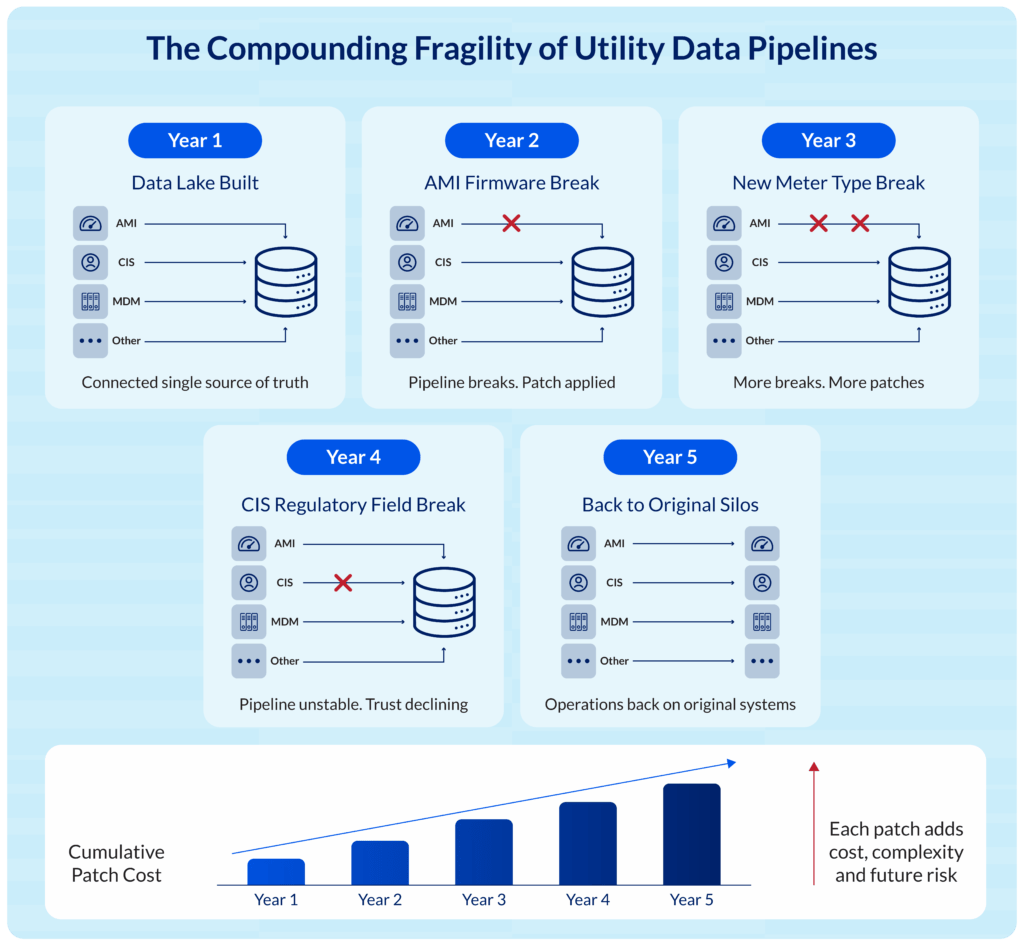
The failure pattern is consistent:
- A firmware update changes AMI output → ingestion pipelines fail
- A new meter type deploys → schema mappings break
- A CIS regulatory field changes → extraction jobs stop
- Dashboards continue showing stale operational figures
- Operators lose confidence in the centralized layer
- Teams return to manual coordination
Every new operational layer inherits the same fragmented coordination foundation underneath it. It is organizational fragmentation.
Most utilities centralized data technically before centralizing accountability operationally.
Integration architecture cannot remain stable when:
- Ownership is ambiguous
- Authoritative systems are undefined
- No governance structure exists to resolve operational conflicts across OT and IT
That is why many modernization initiatives create a second layer of operational complexity instead of reducing fragmentation itself.
The architecture failed because governance was treated as a downstream exercise instead of the operational foundation.
Utilities attempting large-scale operational coordination across fragmented environments repeatedly discover that unstable interoperability and not data volume that becomes the real operational bottleneck. Prudent’s Data-Connected Enterprise Platforms help establish more reliable coordination across operational systems before new deployments compound the same fragmentation.
The OT/IT Accountability Gap Fragmenting Utility AI Operations
Seven systems. Seven operational owners. No shared accountability for the intelligence layer connecting them.
This is where utility data architecture stops being an IT issue and becomes an enterprise operating model problem.
Neither OT nor IT typically owns the cross-system operational truth layer required to sustain coordinated grid operations at scale.
Every integration initiative becomes constrained by organizational boundaries:
- What individual teams expose
- What systems are treated as authoritative
- What operational conflicts nobody has authority to resolve
The asset identity problem exposes this immediately.
The same physical transformer often carries different identifiers across:
|
|
|
|
|
Without a governed master asset registry, every integration initiative builds temporary translation logic that breaks during the next source-system update.
As fragmentation increases:
- Reconciliation labor increases
- Restoration coordination slows
- Operational trust declines
- Field teams bypass centralized systems altogether
Utilities do not struggle because operational data is unavailable.
They struggle because operational truth is fragmented across systems that were never governed together.
AI systems deployed across disconnected operational environments inherit the same fragmented asset context, coordination gaps, and inconsistent operational trust already affecting grid operations.
Before scaling additional operational programs, utilities need to evaluate whether the underlying architecture can sustain operational trust across OT and IT environments.
Prudent’s Data Governance & Trust Solutions establish the semantic foundation and ownership structure fragmented integration programs cannot create independently.
How to Fix Fragmented Data Across Utility AI Grid Operations
Utilities making measurable operational progress share one structural characteristic:
They govern operational data as infrastructure rather than treating it as an application byproduct.
| Operational Area | Fragmented Architecture | Unified Data Layer |
|---|---|---|
| Predictive Maintenance | Sensor and asset data fail to align reliably | Telemetry connected to maintenance history |
| Outage Response | Manual aggregation across disconnected systems | Shared visibility into assets, crews, and customer impact |
| Compliance Reporting | Manual reconciliation slows audit readiness | Automated lineage and traceability built into the architecture |
| Alert Triage | High false positives with limited operational context | Cross-system alert validation reduces unnecessary dispatches |
| Capital Planning | Conflicting data across GIS and ERP systems | Consistent asset models support defensible planning |
Govern Before Integrating
Utilities must establish:
- Authoritative systems per data domain
- Operational ownership accountability
- Escalation authority for data conflicts
- Governance standards spanning OT and IT environments
The moment operational conflicts can be resolved through named ownership structures, integration layers become significantly more stable.
Build the Shared Asset Registry First
Most utilities postpone the governed asset identity layer until later phases. That decision is often what causes modernization programs to stall.
A shared operational asset registry enforcing consistent identifiers across: AMI, GIS, SCADA, OMS, EAM and CIS eliminates much of the reconciliation layer currently embedded into outage operations, maintenance coordination, and regulatory reporting.
Build Shared Operational Coordination Instead of Centralizing Everything
The goal is not replacing every legacy system.
The goal is establishing a governed operational intelligence layer capable of federating trusted system context in near real time without creating brittle extraction dependencies.
Utilities improving operational reliability reduce fragmentation by governing interoperability rather than forcing complete platform replacement.
That architecture approach strengthens these simulataneously:
- Restoration coordination
- Outage response
- Operational trust,
- Compliance traceability
- Field execution
None of this requires replacing legacy systems. The fix sits above the existing operational environment.
The Governance Decision Utility AI Cannot Skip
Utilities still trapped inside the silo problem often respond the same way: more dashboards, more pipelines, and more AI-driven operational layers on top of fragmented operational foundations.
The defining decision is not which platform gets selected next. It is whether utility leadership establishes:
- A governed cross-system operational truth layer
- Authoritative ownership by data domain
- Executive accountability capable of enforcing standards across OT and IT boundaries
Without that coordination layer:
- Utility AI systems inherit fragmented asset context
- Operational trust across systems remains inconsistent
- Disconnected workflows continue slowing restoration coordination
- Field operations continue operating without reliable cross-system alignment
It is solved by governing operational truth as shared enterprise infrastructure.
Prudent works with utility CIOs, CDOs, and operations leaders to evaluate whether their current data architecture can sustain operational reliability, AI deployment readiness, regulatory defensibility, and coordination demands before the next deployment compounds the same fragmentation underneath it.
Your grid systems may already be connected. The question is whether they can coordinate reliably under operational pressure and support reliable AI-driven grid operations.
We identify where fragmentation is slowing operational execution across your grid environment.
Book an Architecture Evaluation Now